By Samuel Olusegun Precious
Twenty-five years after the September 11, 2001 terrorist attacks, the events of that morning remain a defining moment in modern history, reshaping the way people fly, cross borders and confront terrorism.
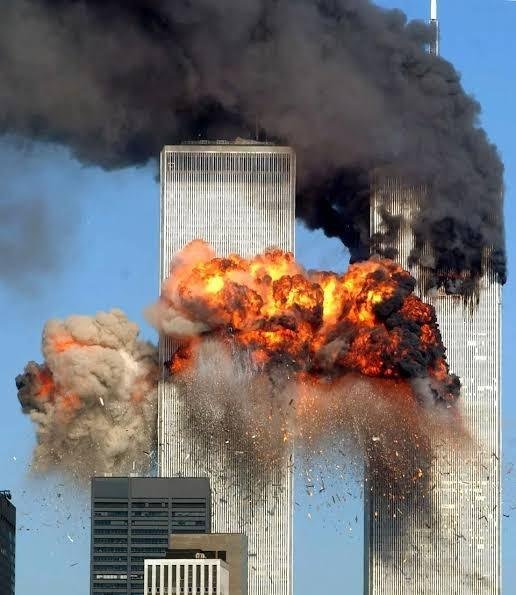
On Tuesday, September 11, 2001, 19 al-Qaeda hijackers seized control of four commercial airliners in the United States. American Airlines Flight 11 and United Airlines Flight 175 were deliberately flown into the Twin Towers of the World Trade Center in New York.
American Airlines Flight 77 crashed into the Pentagon in Washington, D.C., while passengers aboard United Airlines Flight 93 attempted to regain control of their aircraft. The plane eventually crashed near Shanksville, Pennsylvania.
Nearly 3,000 people were killed in the attacks, making 9/11 one of the deadliest terrorist attacks in history.
A New Era for Air Travel
Before 9/11, airport security procedures were significantly less restrictive than those passengers experience today. Items such as small knives, lighters and liquids were permitted under rules that would later change dramatically.
The attacks exposed vulnerabilities in commercial aviation and prompted governments and the aviation industry to overhaul security procedures.
Cockpit doors were reinforced and designed to remain locked during flights, while passenger screening became more extensive. Airport authorities introduced or expanded the use of body scanners, shoe screening and more rigorous passenger checks.
Passenger information and watchlists also became increasingly important tools in aviation security, with governments expanding systems for identifying individuals considered potential security threats.
Air marshals were deployed on selected flights, while international aviation security standards were strengthened through cooperation involving countries and global aviation bodies.
The restrictions on liquids in cabin baggage were tightened further following the 2006 United Kingdom liquid-bomb plot, eventually contributing to the familiar 100-millilitre limit that became standard at airports around the world.
The transformation came with significant costs. Airlines faced major disruption in the immediate aftermath of the attacks, while the aviation industry experienced financial losses and changes to insurance and liability arrangements.
For passengers, air travel that once involved relatively brief security checks evolved into a process that could require hours at major airports.
From 9/11 to the War on Terror
The consequences extended far beyond airports.
The United States launched military operations in Afghanistan in 2001 with the stated objective of dismantling al-Qaeda and targeting the Taliban government that had provided its sanctuary. The US-led invasion of Iraq followed in 2003.
For the first time, NATO invoked Article 5 of its treaty, declaring that an armed attack against one member would be treated as an attack against all.
Governments also introduced new laws and institutions to confront terrorism. In the United States, the USA PATRIOT Act expanded government surveillance and investigative powers, while the Department of Homeland Security was established in 2002 to coordinate major aspects of national security.
At the international level, United Nations Security Council Resolution 1373 called on countries to strengthen measures against terrorism, including efforts to prevent terrorist financing and improve international cooperation.
Intelligence sharing expanded as agencies and countries sought to identify and disrupt terrorist networks before attacks could take place. Financial monitoring and sanctions were also increasingly used to trace and restrict sources of terrorist funding.
A Permanent Security Debate
The fight against terrorism also changed from a largely reactive approach to one increasingly focused on prevention, disruption and counter-radicalisation.
Special operations, drone strikes, expanded intelligence gathering and cyber-monitoring became part of the broader counter-terrorism toolkit.
A quarter of a century later, the security architecture created or expanded after 9/11 remains a part of everyday life. Biometric screening, intelligence databases, joint security operations and increasingly sophisticated technologies continue to shape how governments identify and respond to potential threats.
But the transformation has also generated a continuing debate over the balance between security and individual freedoms.
Measures introduced in the name of counter-terrorism have raised persistent questions about privacy, surveillance, civil liberties and the extent of government power.
The legacy of September 11 therefore extends beyond the destruction of the World Trade Center, the attack on the Pentagon and the crash of Flight 93.
It changed the experience of flying, influenced border and intelligence policies, transformed counter-terrorism strategies and deepened international security cooperation.
Twenty-five years on, the world continues to live with the consequences of that morning.
We remember the victims of September 11 and the lives forever changed by the attacks.